
 About Us
 Contact Us
 020 8892 3813



 Free Delivery Over £99*
 1 Hour Delivery Window*
 Earn Loyalty Points
 Red Hot Deals
 Gift Ideas
 Our Reviews
Why microns matter more than marketing
Understanding particle size - and why it changes everything about dust control
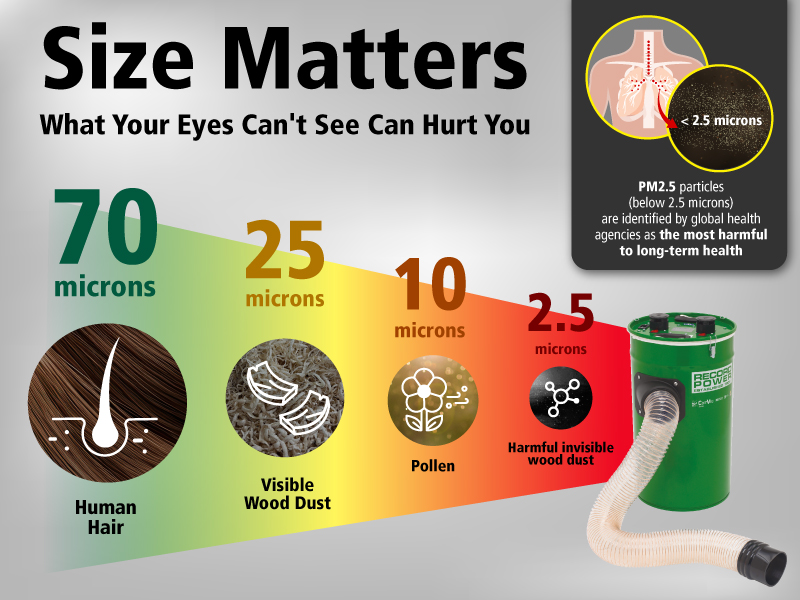
Once you understand microns, you will never look at a dust extractor specification the same way.
A micron is one-thousandth of a millimeter. A human hair is around 70 microns wide. The wood dust you can see settling on your bench is no smaller than 25 microns. But the dust that causes the most lasting lung damage sits in the PM2.5 range - particles below 2.5 microns - where particles are too small to see, too small for your body to intercept easily, and small enough to reach the deepest lung tissue where they can accumulate over years.
|
The key insight: PM2.5 - particles smaller than 2.5 microns - is the benchmark used by international health agencies for a reason. It identifies the fraction of airborne particulate matter most consistently associated with long-term respiratory and cardiovascular harm. When evaluating a dust extractor, filter efficiency in the PM2.5 range under real operating conditions is a more meaningful measure of health protection than any nominal threshold ratin |
This is why a basic cotton bag filter on the exhaust of a chip collector - typically rated at 15 to 30 microns - offers no meaningful protection against the particles most harmful to health. And it is why understanding what filter ratings actually measure matters far more than headline specs like horsepower or airflow volume.
The article explains which particle sizes go where in the body, what health risks each size range carries, and what the difference is between a filter's nominal threshold and its real-world efficiency.
 My Account
 About Us
 Find Us
 MON - SAT 08:30 - 17:30
 020 8892 3813