
 About Us
 Contact Us
 020 8892 3813



 Free Delivery Over £99*
 1 Hour Delivery Window*
 Earn Loyalty Points
 Red Hot Deals
 Gift Ideas
 Our Reviews
Most performance problems in dust extraction start before the hose is even connected
Inlet sizes and reducers: the practical detail that quietly kills extraction performance
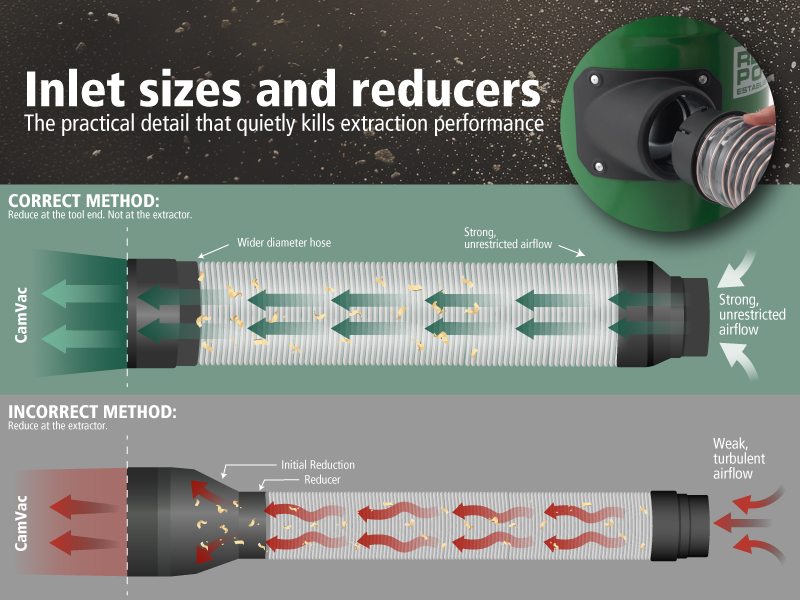
Here is a scenario that plays out in workshops all the time. A woodworker connects their extractor to a benchtop sander using a reducer, notices poor suction, and concludes the machine is not powerful enough. Often the real problem is where - and how - the reduction was made.
The principle is simple: start as wide as possible and reduce only at the point where you connect to the tool. An extractor with a 100mm inlet running a 100mm hose to the work area, reducing to match the tool's port only at the last connection, retains strong airflow and pressure throughout the system. An extractor choked at its own inlet loses performance before the air has even entered the hose - and nothing downstream can compensate.
|
The key insight: Think of it like a straw that gradually narrows only at the tip. Flow stays strong throughout. Narrow it from the beginning and it is restricted no matter what is on the other end. The extractor creates the pressure and airflow. Your job is to preserve as much of it as possible all the way to the tool - and that means keeping the diameter as large as you can for as long as you can. |
The article also explains why a large-inlet workshop extractor can serve tools with small ports effectively, while a compact extractor with a small native inlet cannot be made to work as effectively with larger machines regardless of what adapters are fitted.
→ Read the full article: Inlet Size and Reducers - What Really Matters and Why
 My Account
 About Us
 Find Us
 MON - SAT 08:30 - 17:30
 020 8892 3813